Evelyn and Hawthorne Smyth Sanctuary
Essex Street, Deep River
General Property Overview…
2.3 acres of freshwater
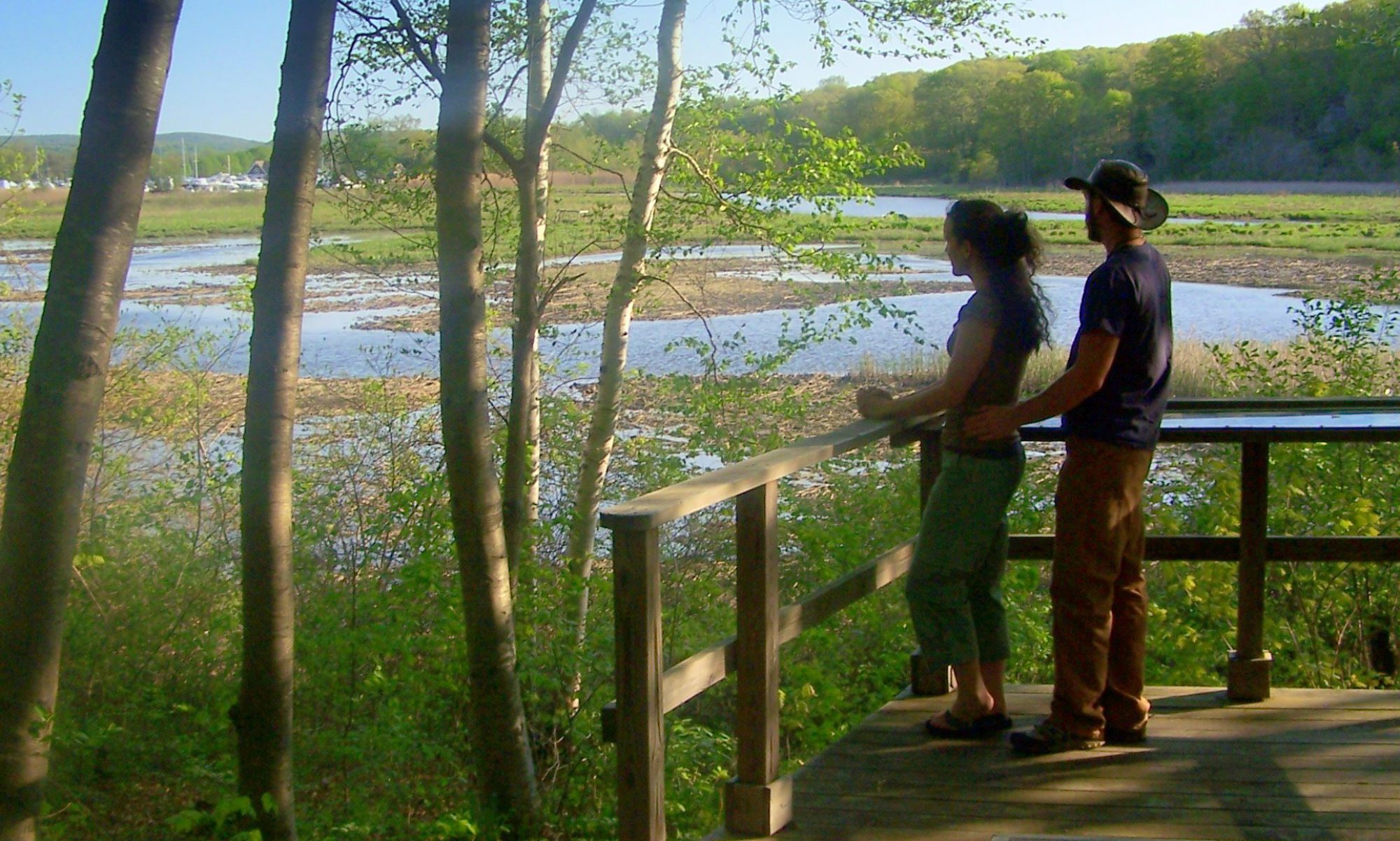
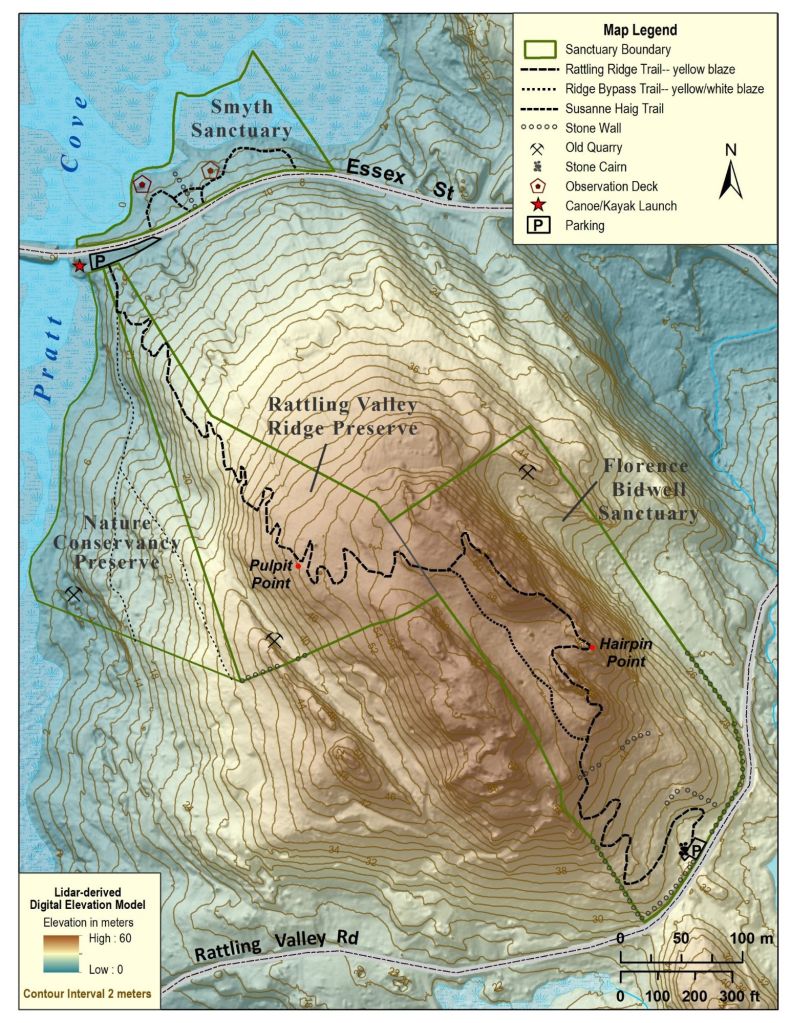
tidal marsh and small area of adjacent upland with a short trail, viewing platform and signage explaining features of the Cove. Access off Essex St. Newly acquired small open area to west offers pleasant Cove vistas.
Trail Description: Short trail leads to viewing platform overlooking water and osprey nest site.
Notable Flora: Various native plants, and fruiting trees.
Wildlife Highlights at the Smyth Sanctuary/Pratt Cove
By virtue of their ability to produce their own food using photosynthesis, plants serve as the basis of the food chains of most of our planet’s ecosystems. Tidal freshwater conditions that characterize the Pratt Cove wetlands support a diverse and unique flora that includes hundreds of plant species.
Conspicuous from the two observation platforms, one can view a patchwork of emergent plants that are rooted in the muddy substrate of tidal flats including large areas of native wild rice (Zizania aquatica). In pre-colonial America, this member of the grass family was an important source of food for native peoples. This large annual grass is most obvious from late spring, summer and into early fall, when seeds ripen and red-winged blackbirds and other seed eating birds feast during the day and roost at night. In late fall and winter, seeds in the water and nutrient rich mud, continue to provide critical food and habitat for many species of migrating and wintering waterfowl (see Wildlife of Smyth/Pratt Cove). Smaller areas of cattails (Typhus spp.), sedges (Carex spp.), and rushes (Juncus spp.) dominate at other locations. Unfortunately, extensive stands of the non-native highly invasive common reed (Phragmites australis) line the creek banks to the exclusion of other species near the marina at the entrance to the cove. During the growing season note their appearance as a blue-green leafed monoculture. Interspersed amongst the tall reeds are patches of golden club (Orontium aquaticum), a member of the Arum family listed as a species of concern by the CT DEEP (Connecticut Department of Energy and Environment).
A colorful succession of blooming flowering plants dot the marsh as the growing season progresses. In early spring, native Wild Blue Iris (Iris versicolor) and the non-native invasive yellow flag (Iris pseudacorus) dot the marsh, while in late spring, the yellow flowers of Spatterdock (Nuphar advena) reach for sunlight above their floating lily pads. In the summer months, the deep purple spikes of Pickerelweed (Pontederia cordata), while the spathe covered white spikes of Arrow Arum (Peltandra virginica) and the white clusters of Arrowhead (Sagittaria latifolia) line the deeper water areas. Marsh Ferns (Thelypteris palustris) and Sensitive Ferns (Onoclea sensibilis) in the adjacent shallow muddy areas. Late summer and fall bring on the blooming of many members of the daisy family in the marsh including Joe-Pye Weed (Eutrochium purpureum, E. maculatum), Boneset (Eupatorium perfoliatum) in July followed by showy swaths of yellow-flowered Sneezeweed (Helenium autumnale.) and Beggarticks (Bidens spp.) in late September. The striking flowers of the non-native Purple Loosestrife (Lythrum salicaria) are also conspicuous in July and August. One should always be on the lookout along the shaded banks for the rare and beautiful scarlet blooms of Cardinal Flower (Lobelia cardinalis). In the meadow portion of the preserve, look for Blue-eyed Grass (Sisyrinchium spp.) and Yellow Hawkweed (Hieracium spp.) both are often surrounded by Bedstraw (Galium spp.) in late spring. Also watch for Black-eyed Susans (Rudbeckia spp.) and goldenrod (Solidago sp.) blooming from midsummer to early fall. In the woods near the platform, note in spring the white flowered shrubs Maple-leaved Viburnum (Viburnum acerifolium) and Pepperbush (Clethra) and for Mountain Laurel (Kalmia latifolia) in early June when Connecticut’s State flower typically blooms, along the shore speckled alder (Alnus incana) is abundant. Widely distributed on the forest floor are the herbaceous Wild Sarsaparilla (Aralia nudicaulis) and False Solomon’s Seal (Maianthemum racemosum) flowering in May, Spotted Wintergreen (Pyrola elliptica) in July, and later in September and October, white and purple asters (Aster spp.) carpet the open woods. Christmas ferns (Polystichum acrostichoides) are evergreen and provide much needed color even in the dead of winter. Common native trees on growing in the sanctuary include Black Birch (Betula lenta), Sassafras (Sassafras albidum), Mockernut Hickory (Carya tomentosa), Red Oak (Quercus rubra), White Oak (Quercus alba), Black Cherry (Prunus serotina), American Elm (Ulmus americana), Red Maple (Acer rubrum), Sugar Maple (Acer saccharum). The non-native invasive Norway Maple (Acer platanoides) is abundant in the canopy and understory. Be aware of the three part leaf of poison ivy (Toxicodendron radicans) which is often confused with the five part leaf of the non-poisonous Virginia creeper (Parthenocissus quinquifoila).
*An ongoing DRLT plant management goal at the Smyth Sanctuary is to reduce non-native invasives and promote native species, especially those most attractive to birds and insect pollinators.
Notable Fauna: Ospreys and various shorebirds and songbirds
Deep River Land Trust – Smyth Sanctuary/Pratt Cove Wildlife Highlights
The list of fauna inhabiting Pratt Cove includes a multitude of invertebrates and hundreds of vertebrates.
While walking through vegetation be prepared for ticks, arachnid related ectoparasites that can carry Lyme disease.
Insects abound in these wetlands on, above and below the surface of the cove waters and beware that biting mosquitoes may be abundant during the summer and early fall. Several species of dragonflies and damselflies are regularly seen hovering and landing on vegetation and attached mating pairs can be observed throughout the summer. Among butterflies,Tiger Swallowtails are conspicuous in spring and summer and Monarchs are prevalent during their migration in late summer as they sip nectar from goldenrod and other late blooming flowers.
Freshwater tidal wetlands provide critical habitat and food for many Fish species including bass, bluegills, chain pickerel, northern pike, catfish, minnows and anadromous members of the herring family. The most frequently observed. Reptiles and Amphibians include painted turtles sunning on logs, snapping turtles lurking beneath the surface and banded water snakes, most often spotted swimming along the shoreline. The chorus of frogs and toads are heard from early spring through mid-summer. American toads, spring peepers, and wood, pickerel, green and bullfrogs each provide their species specific breeding calls.
Birds are the most conspicuous vertebrates with over 100 species recorded. Birds of prey observed regularly include Ospreys, Turkey Vultures, Red-tailed and Red-shouldered Hawks. Bald Eagles, Northern Harriers and Peregrine Falcons are less commonly seen. Barred, Great Horned, and Eastern Screech Owls are more often heard than viewed. One or two pairs of the non-native Mute Swans construct large nests in the early spring and feed throughout the year when there is open water. Canada Geese, American Black Ducks, Mallards and Wood Ducks also frequently breed in the sanctuary. Numerous other waterfowl species overwinter or visit during spring and fall migration; Diving ducks such as Buffleheads and three species of Merganser (Common, Red-breasted and Hooded) head the list. The loud rattle of the Belted Kingfisher is heard during all seasons as is the squawk of the Great Blue Heron. Great Egrets feed while wading in shallow water from April to October and in summer Double-crested Cormorants often perch on exposed logs and snags. Songbirds of the cove include Red-winged Blackbirds that arrive in March, breed during the spring and early summer, and then gather by the hundreds amongst the stalks of wild rice in the early fall. Warbling Vireos and Orioles (Baltimore and Orchard) nest in trees near water and Yellow and Yellowthroat warblers, Marsh Wrens, Song and Swamp Sparrows are commonly observed and heard during spring and summer. Tree, Bank and Barn Swallows feed aerially over the marsh when winged insects are abundant. In the meadow Eastern Bluebirds frequently utilize the nestbox and American Goldfinches, Indigo Buntings and Robins are often seen in this area too. Cardinals, Blue Jays,Tufted Titmice, Carolina Wrens, Red-bellied Woodpeckers and other common birds are found in the wooded areas.
Mammals are typically nocturnal and secretive. Late in the day and during the early morning hours, white-tailed deer are often seen in or near the marsh where they feed and find refuge. Red fox, racoon, opossum and muskrat are also occasionally observed while beavers irregularly visit during the spring and fall. Coyotes, bobcats, mink, fishers, striped skunk, and river otters are rarely seen but more likely detected by their sign. In the woods and meadows adjacent the marsh, many rodent species abound, including mice, voles, chipmunks and squirrels. In the past, cottontail rabbits, a lagomorph( not a rodent), have been spotted in the meadow and nearby residential lawns.
Notable Fungi: To be added.
Geological Information: To be added.
Regional Hydrology Information: borders a Tidal marsh
Early History and Important Notes :
John Cunningham is the Steward of this property, a neighbor, and long time visitor to Smyth he now is the lead of various ongoing programs to manage the site well.
Acquisition
Donated /Purchased
Acerage
2.3 acres
Public Access
This property is open to the public and has viewing platforms and a short trail
Adjacent Properties
Rattling Valley Ridge

 Deep River Land Trust